Application_Development_SDLC-Module-1
2026-08-05 15:47
Tags: #ADET
Author: Duke Hsu
Topic
- Application Development Life Cycle
- Types of Applications
- Emerging Technology Trends
- Modern Development Tools
1.0 Software Development Life Cycle
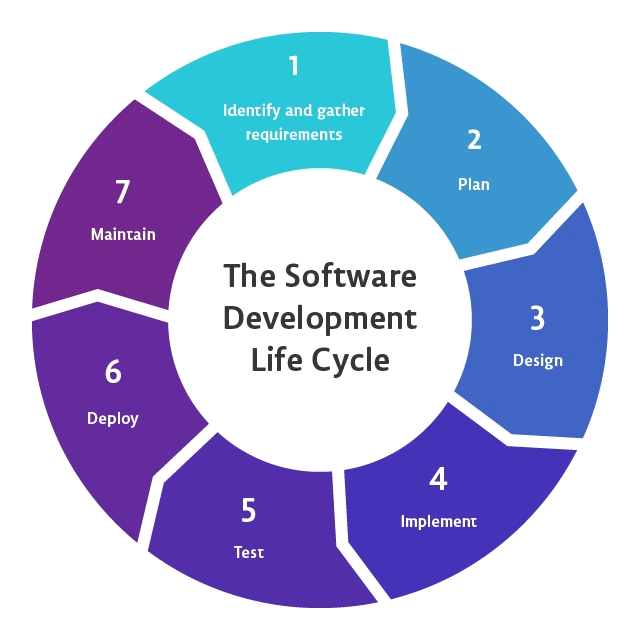
Planning & Analysis
Planning
-
Define project goals and scope
-
Identify stakeholders and users
-
Estimate time, cost and resources
-
Create project timeline & risks
-
Establish success metrics
Analysis
-
Gather user requirements
-
Document functional needs
-
Analyze business processes
-
Create use cases & user stories
-
Identify system constraints
-
Validate requirements with users
Design & Implementation
Design
-
Create system architecture.
-
Design database structure.
-
Design user interface (UI/UX).
-
Define data models & APIs.
-
Create prototypes & wireframes.
-
Select technology stack.
Implementation(Coding)
-
Write clean, modular code.
-
Follow coding standards.
-
Use version control(Git).
-
Implement features iteratively.
-
Conduct code reviews.
-
Document the code
Testing , Deployment & Maintenance
Testing
-
Unit testing
-
Integration testing
-
System testing
-
User Acceptance Testing (UAT)
-
Bug fixing & regression.
Deployment
-
Release planning
-
Environment setup
-
Data migration
-
Go-live activities
-
User training
Maintenance
-
Bug fixes & patches
-
Performance monitoring
-
Feature enhancements
-
Security updates
-
User support
2.0 Types of Applications
Desktop Applications
Software programs installed and run on a personal computer or workstation. They have full access to system resources and can work offline.
Web Applications
Applications accessed through a web browser over the internet. No installation required , uses can access them from any device with a browser.
| Applications type | Example | Advantages | Disadvantages | Technologies |
|---|---|---|---|---|
| Desktop Applications | MS, PS, VS code, Obisidian etc.. | Fast, performance, offline, many features | Platform dependent, manual updates, installation required | C++, Csharp,Java, Electron, .NET, Python,rust, |
| Web Applications | Gmail, FB,Netflix, ...etc | Cross platform, easy updates, accessible anywhere | Internet required, browser limitations, security concerns | php,Node.js,JavaScript, html, css, react, mysql |
Mobile Applications
Applications designed specifically for smartphones and tablets. Can be native (iOS/Android), hybrid, or progressive web apps(PWA).
-
Native Apps - Built for specific OS(Swift/Kotlin) , best performance
-
Hybrid Apps - Cross platform(React Native, Flutter) one codebase, run many platform.
-
PWA - Web apps that behave like native apps offline
-
Examples - INS, Grab, GCash, Tiktok, LALAMOVE, etc
Cloud Applications
Applications hosted on cloud infrastructure(AWS, Azure, GCP), Users access them via internet. Highly scalable and accessible from anywhere
-
SaaS - Software as a Service , ready to use apps (Office 365, salesforce)
-
Advantages - Scalable, cost-effective, automatic updates, high availability
-
Examples - Google Workspace, Dropbox, Slack, Zoom, Canva
-
Key Benefit - Pay only for what you use , no expensive hardware needed.
3.0 Emerging Technology Trends
Technologies shaping the future of application development
-
Artificial Intelligence
-
Cloud Computing
-
Internet of Things(IoT)
-
Blockchain
-
Low-Code / No-Code
Artificial Intelligence in Development
-
Generation Code - GitHub Copilot, ChatGPT, and Claude can write and suggest code
-
Automated Testing - AI tools detect bugs and generate test cases automatically
-
Digital content generation
-
Natural Language - Voice assistants and NLP-powered interfa
-
Predictive Analytics - Forecast user behavior and system per
-
AI - Powered IDEs - Intelligent code completion and error detection
Cloud Computing Trends
-
Serverless Computing - Run code without managing servers
-
Edge Computing - Process data closer to users for lover latency
-
Cloud-Native Apps - Built specifically to take advantage of cloud capabilities
-
Multi-Cloud Strategy - Use multiple cloud providers for flexibility ad risk reduction
-
Containerization - Docker & Kubernetes for portable, scalable applications
-
Cost Optimization - Auto scaling and pay-as-you-go models reduce expenses
Internet of Things (IoT)
IoT connects everyday devices to the internet, enabling them to collect and exchange data , this creates opportunities for smart applications in homes, cities, healthcare, and industry.
-
Smart home - Light, thermostats, security cameras
-
Healthcare - Wearables, remote patient monitoring
-
Agriculture - Soil sensors, automated irrigation
-
Industry 4.0 - Predictive maintenance, smart factories
Blockchain Technology
A decentralized, immutable digital ledger that records transactions across many computers. Originally created for cryptocurrencies, it is now used for secure data sharing, supply chain, and digital identily.
-
Decentralized - No single point of control of failure
-
Immutable - once recorded, data cannot be changed
-
Transparent - All participants can view the ledger
-
Secure - Cryptography protects against fraud
Low -Code / No - Code Platforms
Platforms that allow users to build applications with minimal or no traditional coding. They use visual interfaces, drag-and-drop components, and pre-built templates.
-
Faster Development - Build apps in days instead of months
-
Citizen Developers - Business users can create solutions
-
Lower Cost - Reduce dependency on specialized developers
-
Examples - MS Power Apps. Bubble, OutSystems, Mendix
4.0 Web Development Framework
Laravel
- Modern PHP framework . Elegant syntax, built-in security, MVC architecture, and powerful tools for rapid web development.
MySQL
- Open-source relational database, Reliable, fast, and widely used with PHP for storing application data securely
PHP
- Server-side scripting language widely used for web development. Powers Wordpress, Facebook, etc