Module - 2 AI In. Software Development
2026-08-18 16:16
Tags: #ADET
Author: Duke Hsu
Topic
- AI and Machine Learning
- AI in Software Development
- AI Assisted Programming Tools
- Prompt Engineering for Developers
- Ethical and Responsible AI
1.0 Artificial Intelligence
Everyday AI
- Siri
- Google Assistant
Business AI
- Customer service
- Chatbots
- Fraud detection
- Predictive analytics
- Face recognition
Development AI
- Code generation
- Bug detection
- Automated testing documentation
1.1 What is Machine Learning
Supervised Learning
- Label
1.2 AI vs Machine Learning
Artificial Intelligence
- Can be rule-based or data-driven
- Broader concept of machines mimicking human intelligence .
Machine Learning
- Algorithms
- Training
1.3 Generative AI
Text , Image , Video , Code
2.0 Generative AI in Software Development
- Faster Coding
- Documentation
- Test Generation
- Bug Detection
- Code Explanation
- Learning Aid
3.0 Prompt Engineering
Provide a good instructions for the AI
- Better Results
- Less Rework
- Control
- Career Skill
Techniques
- Be Specific
- Give Context
- Specify Format
- Use Role Prompting
- Iterate
- Provide Examples
4.0 Ethical Issues in AI for Software Development
- Bias in AI
- Over-Reliance
5.0 Responsible AI Practices for Developers
- Always Review AI output
- Protect Sensitive Data
- Check for Bias and Fairiness
- Give Credit and Be Transparent
- Stay Updated on Policies
- Keep Learning
LAB AI Frameworks and Tools in 2026
- PyTorch
- TensoFlow
- JAX
- Hugface Transformers
- ONNX
Compare it / How to use it ?
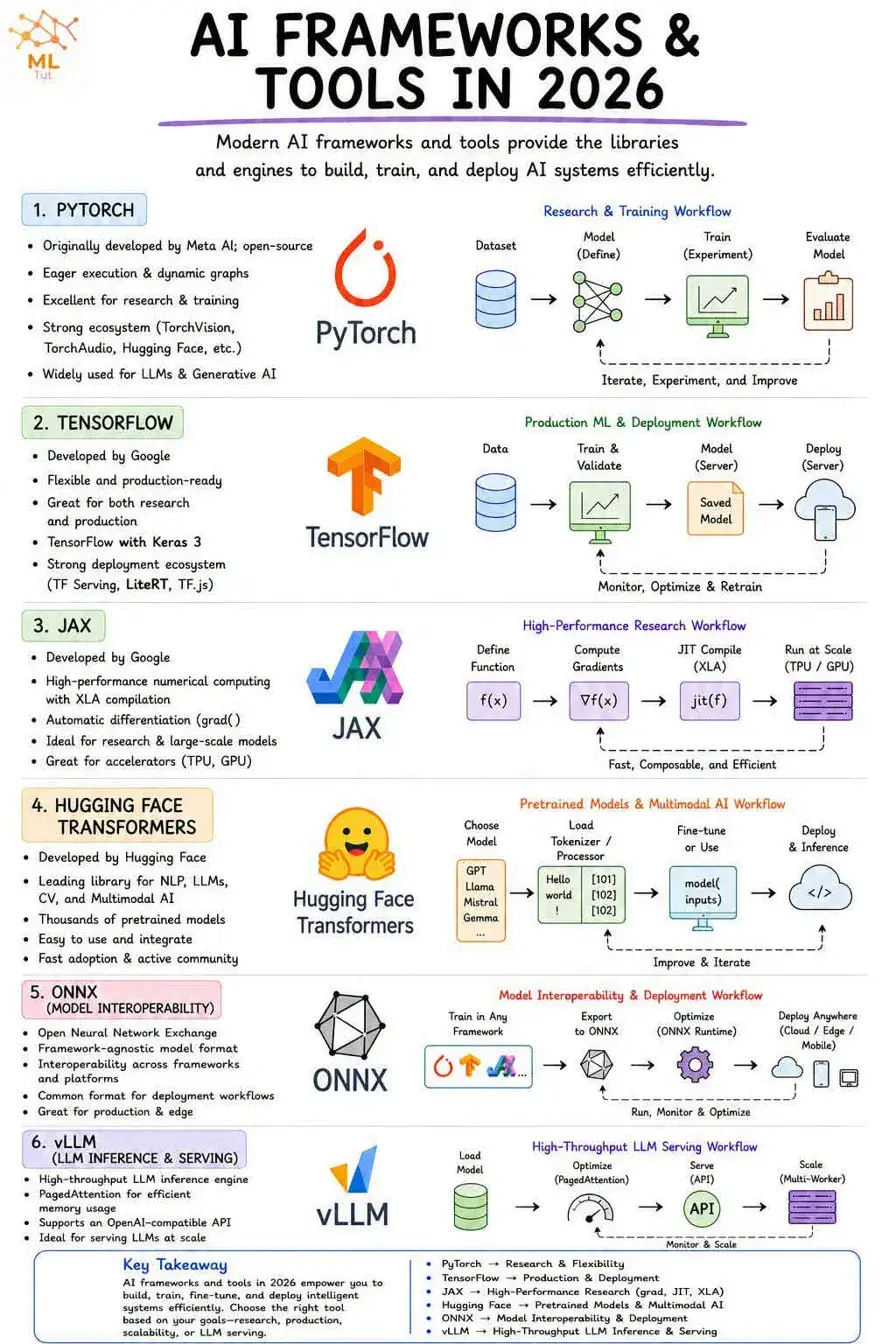
AI 框架/工具總覽表
| 工具 | 工作方式(部署/執行模式) | 典型用法 | 適合場景 | 工作邏輯(流程) |
|---|---|---|---|---|
| PyTorch | 動態計算圖(Eager Execution),程式執行到哪、圖就建到哪,方便除錯 | 研究、模型設計、訓練、生成式AI開發 | 需要快速實驗、調整模型架構、做研究的場合;目前多數LLM研究都用它 | 準備資料集 → 定義模型 → 訓練(反覆實驗) → 評估模型 → 根據結果再迭代 |
| TensorFlow | 靜態圖 + Keras 3 高階API,強調可攜性與正式環境部署 | 訓練模型後導入生產環境(伺服器、行動裝置、瀏覽器) | 公司要把模型長期穩定運行在正式產品中,需要跨平台部署(TF Serving、瀏覽器用TF.js、行動裝置用LiteRT) | 資料輸入 → 訓練與驗證 → 存成Saved Model → 部署到伺服器/裝置 → 持續監控、優化、重新訓練 |
| JAX | 函數式程式設計 + XLA 編譯加速,強調自動微分與可組合的運算 | 高效能數值運算、大規模模型研究、需要極致運算效能的場合 | 需要在TPU/GPU上跑大規模、高速的數學運算或研究型大模型 | 定義函數 f(x) → 自動計算梯度 ∇f(x) → 用JIT編譯成機器碼(XLA) → 在TPU/GPU叢集上大規模執行 |
| Hugging Face Transformers | 提供統一介面呼叫上千個預訓練模型,不用從零訓練 | 直接使用或微調現成的NLP/LLM/電腦視覺/多模態模型 | 開發者想用現成的Llama、GPT類模型,而不是自己從零訓練一個 | 選擇模型(GPT/Llama/Mistral等) → 載入對應的Tokenizer處理輸入 → 微調或直接使用模型 → 部署做推論 → 持續改進迭代 |
| ONNX | 定義一種「框架中立」的模型交換格式,把模型轉成通用格式後可在不同執行環境跑 | 把某框架訓練好的模型轉換成可跨平台部署的通用格式 | 公司用A框架訓練,卻要在B平台(如手機、邊緣裝置、不同雲端)上運行時 | 用任一框架訓練模型 → 匯出成ONNX格式 → 用ONNX Runtime做優化 → 部署到雲端/邊緣裝置/行動裝置等任何平台 |
| vLLM | 高吞吐量的LLM推論引擎,核心技術是PagedAttention高效管理記憶體 | 大規模同時服務多個使用者的LLM推論請求 | 公司需要讓很多使用者同時跟一個LLM對話、且要求低延遲高併發時 | 載入模型 → 用PagedAttention優化記憶體使用 → 透過相容OpenAI的API對外提供服務 → 多工作節點做水平擴展 |
一句話總結對照(可以直接用在第13題的論證邏輯裡):
- PyTorch → 研究與靈活實驗
- TensorFlow → 正式環境訓練與部署
- JAX → 高效能研究運算
- Hugging Face → 預訓練模型與多模態應用
- ONNX → 跨框架/跨平台模型互通
- vLLM → 大規模LLM推論服務